

How Do You Draw A Planar Head
Lesson 3 - Planes and Head Construction
In lesson three of the portrait prep series, I'thousand going to give an overview of Planes and Head Construction. Nosotros'll be using the Asaro head, the Reilly method, and the Loomis method. (No inkling what that means? No problem! I'll explain in a 2nd.)
Head construction is and then important because information technology in involves the entire head -- not just an isolated wait at the face, or the sides of the confront, or just features. It provides you lot with a framework which you can build upon. This as the final puzzle slice that enables you to begin your journey in drawing portraits!
The Asaro Caput
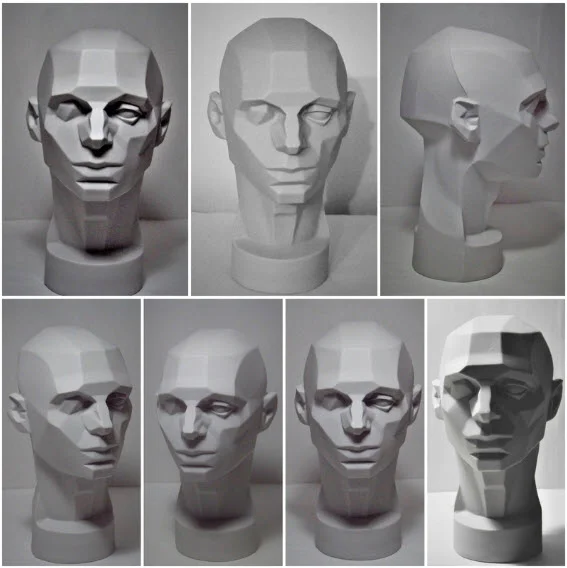
The first method to discuss is the Asaro head. I know of no better way to understand the shading of the head than this model. This is a 3-D model of the head created by John Asaro and helps our overall understanding of how calorie-free is reflected on the surfaces of the head.
When we study portraiture, we are learning the exaggerated planes and angles of an object that nosotros often retrieve of as circular or spherical. Together nosotros can do looking at the model head (fifty-fifty if we're just using a reference photograph of the head) and draw it from our point of view.
Asaro Head Practice
Written report the images in the graphic beneath and notice how the lite in reflected on each plane of the head.
Cardinal things to look for in this challenge:
1. How many light sources are there?
2. Where is the lite source?
iii. Tin yous determine (and label) the value of each plane from i to 10?
4. How many planes are represented inside each characteristic?
Caput Construction Methods
There are two methods that are most pop for constructing the caput: the Loomis method, and the Reilly brainchild method.
Someone may ask the question: Why should I learn methods for how to construct the head? Tin't I just re-create from a photo instead?
Caput drawing methods are giving you ii essential benefits a photograph can never provide:
i. The relationship of the features. (All the features are interconnected and have a relationship to each other.)
two. A mode to label what y'all see. We're talking about a vocabulary and a linguistic communication for something otherwise undefined. If something is undefined, then it's abstract and can remain elusive. As realists, we can't describe something we can't see or define.
The best ways to acquire head construction is to go on practicing it. Practice the things you learn often and keep pushing yourself and y'all Volition come across results.
So with that backdrop, let'southward dig in!
Practicing the Loomis Method
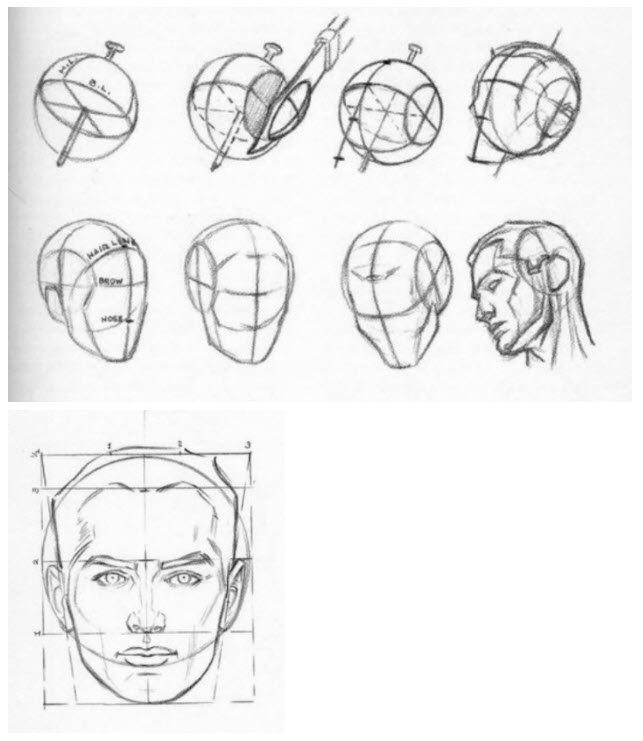
The Loomis method is explained in detail in Andrew Loomis'southward book, "Drawing The Head and the Hands". It's a free ebook and can exist found on google easily (y'all tin go here: Loomis Book). Refer to the images below the steps from the Loomis book.
These are the basic steps that we want to keep in mind for our purposes in portraiture:
-
Draw a round ball.
-
Draw a vertical middle line (center of the olfactory organ).
-
Depict a horizontal middle line (heart of the brow).
-
With an imaginary knife cut off the sides of each of the ball to represent the side aeroplane of the head. (The top part of the circle is ii/3 of the summit from the center of the circumvolve. This is too where the hairline should be. The lesser part of the circle represents the bottom of the ear and is the same plane for the bottom of the nose.) You will besides have to decide where the circle curves at the side aeroplane of the face.
-
Determine the angle of the side plane by making the line from the ear to the forehead.
-
Then extend the line to the forepart plane.
-
Then render the lower and upper lines parallel to the eye line. This will give you lot the thirds of the face: hairline to brow line, forehead line to base of operations of the nose, base of operations of the nose to bottom of the chin.
-
So side by side draw the bottom of the chin line. Extend the line (create a box similar shape) and describe the jawline.
-
Find the eyes past placing your marker half mode between the summit of the head and the bottom of the mentum.
-
The bottom of the bottom lip is halfway between the base of the olfactory organ and the bottom of the chin.
The Reilly Head Abstraction
Nothing is written downwardly from Frank Reilly. We accept very few writings from his students. I recall that at that place are things nosotros can learn from the Riley method. But mostly we're relying on what his students wrote nearly this method and what these students and and so students of the students were able to communicate most the method.
I matter the Riley method incorporates well is a rhythmical human relationship of the features in the head and face. So every feature has a relationship with the residuum of the features. You could almost employ ane continuous line without Ever Lifting your pencil from the paper to create all of the rhythms in the face up.
Then really the best manner to explain this particular method is to bear witness you in a video I've prepared and you tin can look at the reference that I'1000 picturing here beneath.
For those that sign up for the Portrait Prep Drawing Course, You'll have admission to the video lessons. If yous'd similar to sign up for the course, go here to sign up! We're starting the grade on June i, 2020.
To begin the Riley method you need to have the outline of the head complete. And so information technology doesn't really matter what method you apply to create the caput you simply demand to have the top of the head bottom of the chin in order to fill in the Reilly brainchild Rhythm lines.
1. Commencement with creating a round circle with the vertical and horizontal line in the frontal view.

two. Next move downwards one-third of the mode from the heart of the circle that you created to create the bottom of the chin. This establishes the 3 divisions of the head.

3. Once you have the head outlined and know where the eyes are in relation to the brow line, you can motility to the nose.

iv. The nose is the width of the eyes.
v. Brand the upper line to plant the ball of the nose.

6. Brand the line where the keystone is, and so add together the curved line on each side to connect the keystone to the ball of the nose.
7. Add 2 curved lines from the keystone, to the base of the nose.

8. Create the cage of the mouth line by starting at where the intersection of the side plane crosses the vertical lines that were extended from the corners of the eyes.

nine. Create the band of the face, or laugh line area, past starting at the keystone once again and completing that curve with the jaw line.

10. The mentum line extends from the bottom of the chin and intersects with the muzzle.

11. The mouth is identified past the intersection that only happened with the mentum and muzzle.

12. Institute the cheek bone area (which should already exist showing from our circle earlier).

13. Draw the rhythm line from corner of the mouth, laissez passer by the corner of the olfactory organ to the side plane of the head where the brow ridge is. This is the helps constitute the upper cheek surface area.
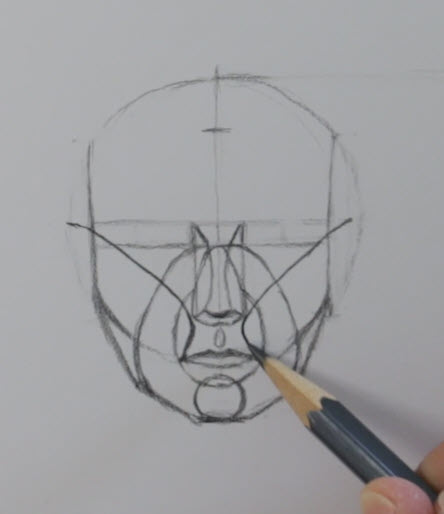
xiv. Commencement from the top of that rhythm that yous only created and make full in the underside of the cheek.
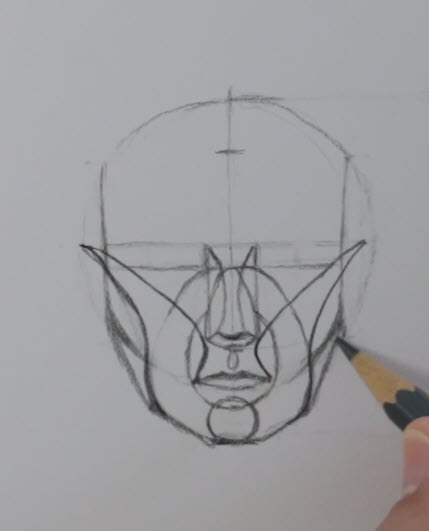
xv. Side by side, connect the ears from the cheek line that you just created to the base of operations of the nose plane.
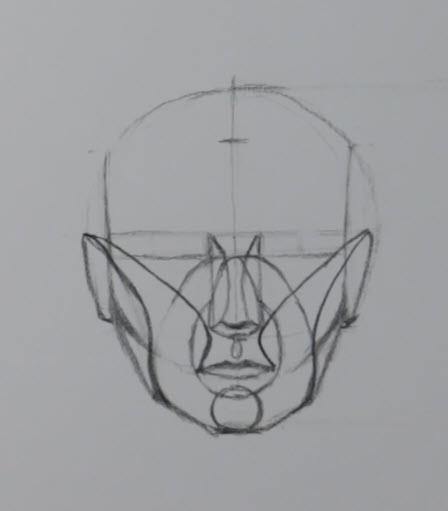
16. Draw the side plane of the face on the brow using the placement of outer area for the optics and cheek as a guide for connecting this line.

17. At present yous can add the curved forehead line.

18. And finally, the eye curved line.
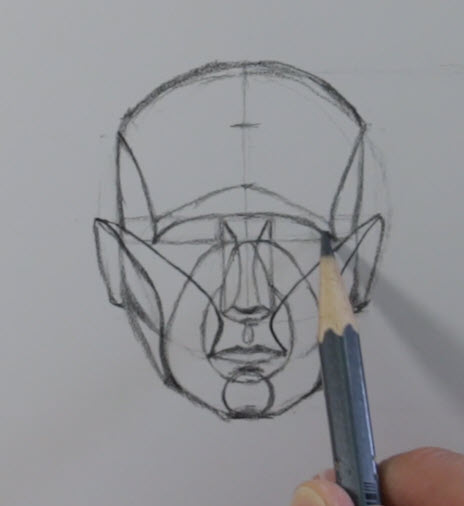
19. You could besides add the center placement as more detail.

Bonus: The John Middick Method
Okay, okay, so I'm not presumptuous enough to call back that anyone is going to name an entire method after me. But I practice think it's benign to share some of the steps I have when doing my own head constructions!
I like to always consider where the head tilt is with each portrait I do. To practice this, I think of iii axes for the management and location of the caput in space:
1. The 10-axes is measured by a line across the pupils. If the line isn't level then the head is tilted. This is a meliorate measurement than slant of eyes or eyelids.
2. The centerline down the olfactory organ, mouth, and chin. If this line is not perfectly centered in that y centrality area then the head is angled or rotated to the right or left. Questions to ask: Do I see more of one nostril than the other? More of one ear? Is one of the corners of the eye behind the olfactory organ?
3. The position of the chin. Where is your eye level position: upwardly or down? Is the bottom airplane of the jaw seen? Do I see the underside of the plane of the olfactory organ or the hairline? These are all clues about the head rotation.
If you tin can answer these questions so you tin begin to understand the tilt of your portrait subject better. Yous'll know how to retrieve most the subject more in a 3 dimensional way.
Recollect: Don't overcomplicate information technology! Just do the construction very simply in the way that feels well-nigh comfortable to yous. As you progress in your sketching with practice, you'll add more and more than detail. The bottom line is to always keep practicing and practicing and practicing.
And at that place you accept it! You've completed the Portrait Prep series. This is just the tip of the iceberg when information technology comes to portraiture, just mastering the skills discussed in these blog posts will give y'all the foundation you need to start drawing the realistic portraits you've always hoped for.

Source: https://sharpenedartist.com/cpblog/portraitseriesl3
Posted by: colemanguideare.blogspot.com
0 Response to "How Do You Draw A Planar Head"
Post a Comment