

How To Draw A Hexagon
Welcome to the hexagon calculator, a handy tool when dealing with whatever regular hexagon. The hexagon shape is one of the most popular shapes in nature, from honeycomb patterns to hexagon tiles for mirrors - its uses are virtually endless. Here we explain not merely why the 6-sided polygon is so pop simply as well how to draw hexagon sides correctly. Nosotros also reply the question "what is a hexagon?" using the hexagon definition.
With our hexagon calculator, you can explore many geometrical properties and calculations, including how to find the area of a hexagon, also as teach y'all how to use the calculator to simplify whatever analysis involving this 6-sided shape.
How many sides does a hexagon accept? Exploring the six-sided shape
Information technology should be no surprise that the hexagon (also known as the "6-sided polygon") has precisely vi sides. This fact is truthful for all hexagons since it is their defining feature. The length of the sides can vary even inside the same hexagon, except when it comes to the regular hexagon, in which all sides must have equal length.
Nosotros will dive a flake deeper into such shape after on when nosotros deal with how to find the surface area of a hexagon. For now, it suffices to say that the regular hexagon is the most common fashion to stand for a 6-sided polygon and the one most often found in nature.
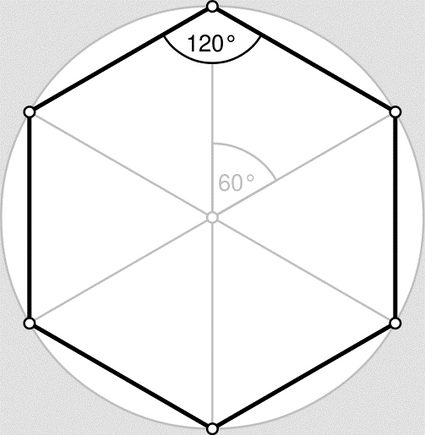
There volition be a whole section defended to the important properties of the hexagon shape, only commencement, we need to know the technical answer to: "What is a hexagon?" Answering this question will help the states understand the tricks we tin can use to calculate the expanse of a hexagon without using the hexagon area formula blindly. These tricks involve using other polygons such every bit squares, triangles and even parallelograms.
Hexagon definition, what is a hexagon?
In very much the same mode an octagon is divers as having eight angles, a hexagonal shape is technically defined every bit having vi angles which conversely ways that (equally you can see in the picture higher up) that the hexagonal shape is always a half dozen-sided shape. The angles of an arbitrary hexagon can take whatsoever value, just they all must sum up to 720º (you can easily catechumen to other units using our angle conversion reckoner).
In a regular hexagon, all the same, all the hexagon sides and angles must accept the same value. For the sides, any value is accustomed as long as they are all the same. These restrictions mean that, for a regular hexagon, calculating the perimeter is and so like shooting fish in a barrel that you don't even need to utilize the perimeter of a polygon calculator if you know a bit of math. Just calculate:
-
perimeter = vi * side
where side refers to the length of any one side.
Every bit for the angles, a regular hexagon requires that all angles are equal and the sum upward to 720º, which means that each individual bending must exist 120º. This fact proves to exist of the utmost importance when we talk virtually the popularity of the hexagon shape in nature. It will as well be helpful when we explicate how to find the area of a regular hexagon since we will be using these angles to figure out which triangle calculator we should use, or even which rectangle nosotros will use in some other method.
Hexagon surface area formula: how to detect the area of a hexagon
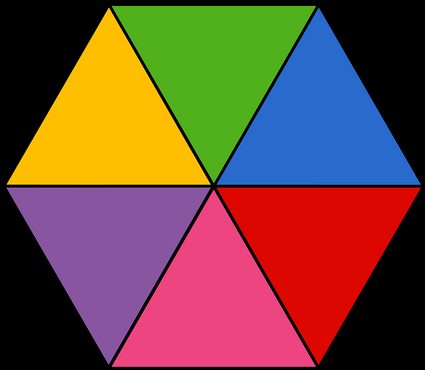
We will at present have a look at how to find the area of a hexagon using different tricks. The easiest way is to use our hexagon calculator, which includes a built-in area conversion tool. For those who desire to know how to practice this past hand, we volition explicate how to detect the surface area of a regular hexagon with and without the hexagon area formula. The formula for the area of a polygon is always the same no matter how many sides information technology has equally long every bit it is a regular polygon:
-
expanse = apothem * perimeter / 2
Just as a reminder, the apothem is the distance between the midpoint of any side and the centre. You can view it as the height of the equilateral triangle formed past taking one side and two radii of the hexagon (each of the colored areas in the image above). Alternatively, ane can also think nigh the apothem as the distance between the center, and any side of the hexagon since the euclidean altitude is defined using a perpendicular line.
If you don't remember the formula, you can always think nearly the 6-sided polygon as a collection of 6 triangles. For the regular hexagon, these triangles are equilateral triangles. This fact makes it much easier to calculate their surface area than if they were isosceles triangles or even 45 45 ninety triangles as in the case of an octagon.
For the regular triangle, all sides are of the aforementioned length, which is the length of the side of the hexagon they form. We will call this a. And the height of a triangle will exist h = √3/ii * a, which is the exact value of the apothem in this case. We remind you that √ means square root. Using this, we tin can start with the maths:
-
A₀ = a * h / 2 -
= a * √three/two * a / two -
= √three/4 * a²
Where A₀ means the area of each of the equilateral triangles in which we accept divided the hexagon. Later on multiplying this area past 6 (considering we accept half-dozen triangles), nosotros get the hexagon area formula:
-
A = 6 * A₀ = half-dozen * √3/4 * a² -
A = 3 * √3/2 * a² -
= (√3/2 * a) * (6 * a) /ii -
= apothem * perimeter /2
We promise you tin meet how we get in at the same hexagon expanse formula we mentioned before.
If y'all want to get exotic, you tin play around with other dissimilar shapes. For example, suppose yous separate the hexagon in one-half (from vertex to vertex). In that example, you get two trapezoids, and you can summate the area of the hexagon as the sum of both, using our trapezoid surface area calculator. You could likewise combine 2 next triangles to construct a total of 3 different rhombuses and calculate the area of each separately. You can even decompose the hexagon in i big rectangle (using the short diagonals) and two isosceles triangles!
Feel gratuitous to play around with different shapes and calculators to see what other tricks you lot can come up up with. Effort to use but right triangles or maybe even special correct triangles to calculate the area of a hexagon! Check out the expanse of the right triangle calculator for assistance with the computations.
Diagonals of a hexagon
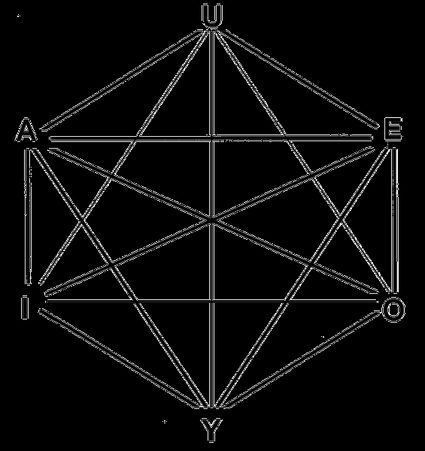
The full number of hexagon'south diagonals is equal to 9 - three of these are long diagonals that cross the central point, and the other six are the so-called "meridian" of the hexagon.
Our hexagon calculator can also spare you some tiresome calculations on the lengths of the hexagon's diagonals. Here is how you calculate the two types of diagonals:
-
Long diagonals - They ever cross the fundamental point of the hexagon. As you can notice from the movie to a higher place, the length of such a diagonal is equal to two edge lengths:
D = 2 * a. -
Short diagonals - They do not cross the key indicate. They are constructed joining two vertices leaving exactly ane in between them. Their length is equal to
d = √3 * a.
Yous should be able to check the argument almost the long diagonal by visual inspection. However, checking the curt diagonals take a bit more than ingenuity. But don't worry, it's not rocket science, and we are certain that you lot can calculate it yourself with a fleck of time; recall that you can always utilize the help of calculators such equally the right triangle side lengths calculator.
Circumradius and inradius
Some other pair of values that are important in a hexagon are the circumradius and the inradius. The circumradius is the radius of the circumference that contains all the vertices of the regular hexagon. The inradius is the radius of the biggest circle contained entirely within the hexagon.
- Circumradius: to find the radius of a circumvolve circumscribed on the regular hexagon, y'all need to determine the distance between the central betoken of the hexagon (that is also the center of the circle) and any of the vertices. It is simply equal to
R = a. - Inradius: the radius of a circle inscribed in the regular hexagon is equal to half of its height, which is as well the apothem:
r = √3/2 * a.
How to depict a hexagon shape
At present nosotros will explore a more practical and less mathematical world: how to depict a hexagon. For a random (irregular) hexagon, the answer is simple: draw any six-sided shape so that it is a closed polygon, and you're done. But for a regular hexagon, things are non so easy since we have to brand sure all the sides are of the same length.
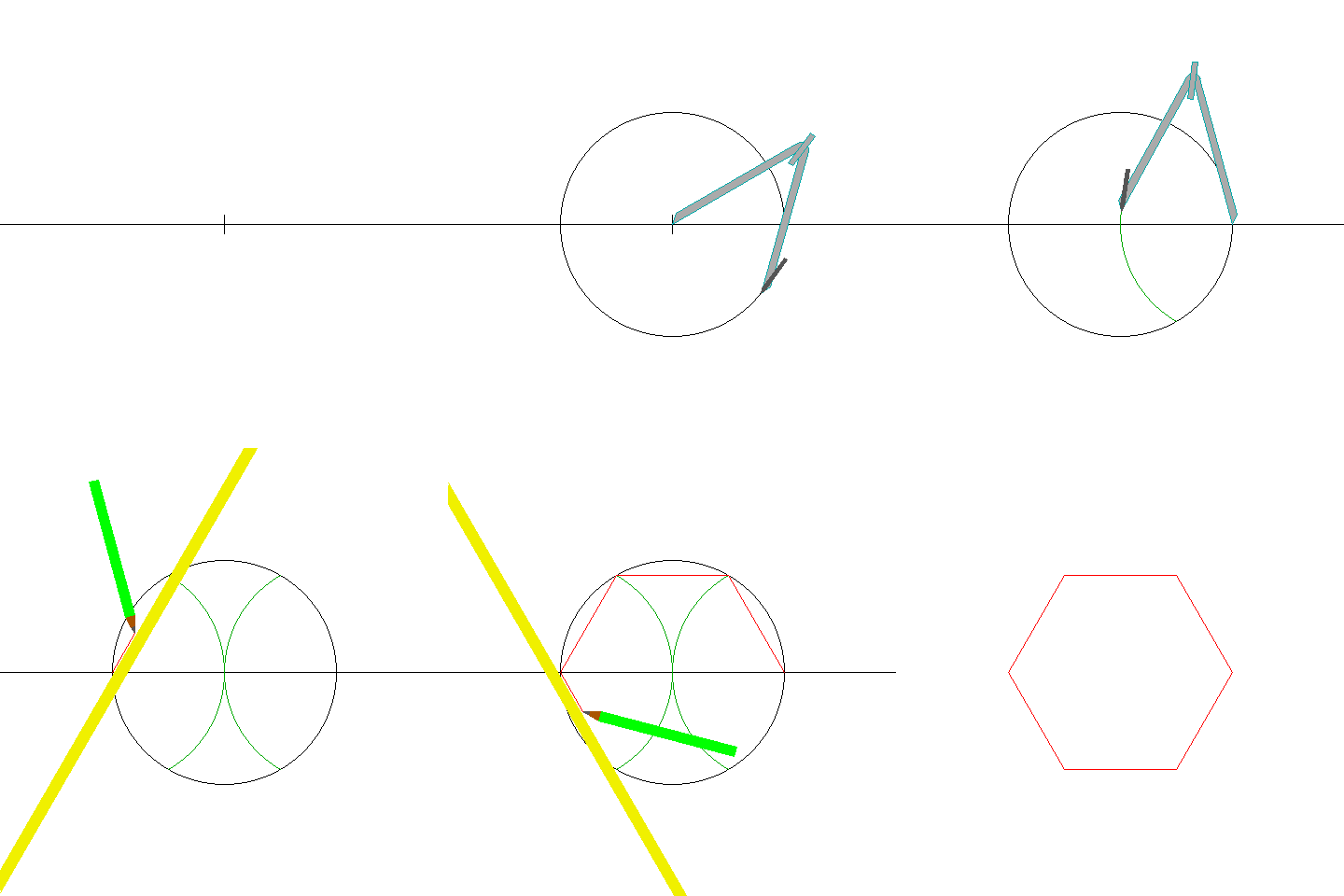
To get the perfect outcome, you will need a drawing compass. Describe a circumvolve, and, with the same radius, start making marks along information technology. Starting at a random point then making the adjacent mark using the previous one as the anchor point, depict a circle with the compass. Y'all will end up with half-dozen marks, and if you lot bring together them with the straight lines, you will accept yourself a regular hexagon. You can run across a similar process in the animation in a higher place.
The easiest way to find a hexagon side, area...
The hexagon computer allows you to calculate several interesting parameters of the 6-sided shape that nosotros unremarkably call a hexagon. Using this calculator is equally unproblematic equally information technology can possibly get with only one of the parameters needed to summate all others and includes a built-in length conversion tool for each of them.
We accept discussed all the parameters of the estimator, only for the sake of clarity and completeness, nosotros will now get over them briefly:
-
Area- 2-D surface enclosed by the hexagon shape; -
Side Length- Distance from 1 vertex to the next consecutive one; -
Perimeter- Sum of the lengths of all hexagon sides; -
Long Diagonal- Altitude from one vertex to the opposite one; -
Curt Diagonal- Distance between ii vertices that have another vertex between them; -
Circumcircle radius- Distance from the center to a vertex (Same as the radius of the hexagon); and -
Incircle radius- Same equally the apothem.
If you similar the simplicity of this calculator, we invite you to try our other polygon calculators such as the regular pentagon reckoner or even 3-D calculators such as the pyramid reckoner, triangular prism calculator, or the rectangular prism calculator.
Hexagon tiles and existent-world uses of the 6-sided polygon
Everyone loves a good real-world awarding, and hexagons are definitely 1 of the most used polygons in the globe. Starting with human usages, the easiest (and probably least exciting) use is hexagon tiles for flooring purposes. The hexagon is an excellent shape considering it perfectly fits with i another to cover any desired area. If y'all're interested in such a use, we recommend the floor reckoner and the square footage computer as they are first-class tools for this purpose.
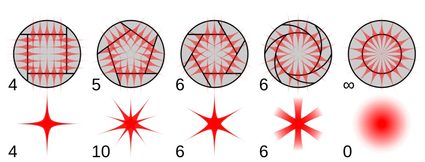
The next case is mutual to all polygons, merely it is still interesting to run across. In photography, the opening of the sensor almost ever has a polygonal shape. This part of the camera is chosen the discontinuity and dictates many properties and features of the pictures produced by a camera. The nearly unexpected 1 is the shape of very bright (point-similar) objects due to the effect chosen diffraction grating, and information technology is illustrated in the picture above.
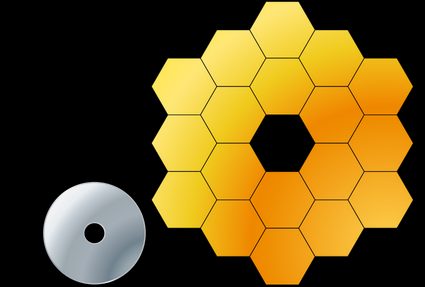
One of the most valuable uses of hexagons in the modern era, closely related to the one we've talked about in photography, is in astronomy. One of the biggest problems we experience when observing distant stars is how faint they are in the dark sky. That is because despite being very bright objects, they are then very far abroad that only a tiny fraction of their light reaches us; you tin learn more about that in our luminosity estimator. On top of that, due to relativistic effects (similar to time dilation and length contraction), their calorie-free arrives on the Globe with less energy than information technology was emitted. This upshot is chosen the red shift.
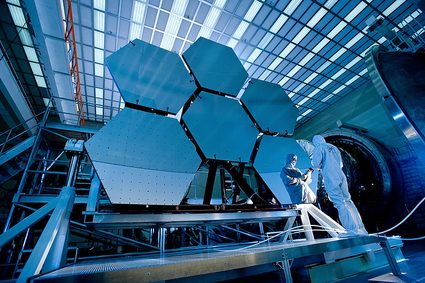
The effect is that we get a tiny amount of energy with a longer wavelength than we would like. The best fashion to annul this is to build telescopes as enormous equally possible. The problem is that making a jumpsuit lens or mirror larger than a couple of meters is almost incommunicable, not to talk about the issues with logistics. The solution is to build a modular mirror using hexagonal tiles similar the ones y'all can see in the pictures above.
Making such a big mirror improves the angular resolution of the telescope, besides equally the magnification cistron due to the geometrical properties of a "Cassegrain telescope". Then we can say that thanks to regular hexagons, we can see better, farther, and more clearly than we could have ever done with just one-piece lenses or mirrors.
Did you know that hexagon quilts are also a affair??
Honeycomb design - why the half-dozen-sided shape is so prevalent in nature
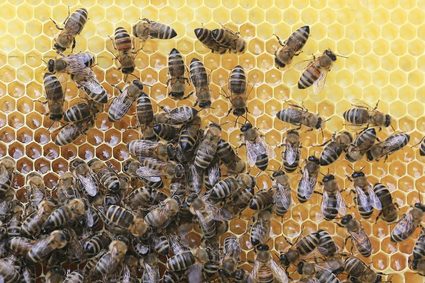
The honeycomb design is composed of regular hexagons arranged side by side. They completely make full the entire surface they span, so in that location aren't any holes in between them. This honeycomb pattern appears non only in honeycombs (surprise!) but also in many other places in nature. In fact, it is so popular that one could say it is the default shape when conflicting forces are at play and spheres are not possible due to the nature of the trouble.
From bee 'hives' to rock cracks through organic chemistry (fifty-fifty in the build blocks of life: proteins), regular hexagons are the most common polygonal shape that exists in nature. And in that location is a reason for that: the hexagon angles. The 120º angle is the near mechanically stable of all, and coincidentally it is also the angle at which the sides encounter at the vertices when nosotros line up hexagons side by side. For the full description of the importance and advantages of regular hexagons, we recommend watching this video.
To those who are hard-core readers, read on (you tin cheque how fast you read with the reading speed calculator).
The manner that 120º angles distribute forces (and in turn stress) among 2 of the hexagon sides makes it very stable and mechanically efficient geometry. This is a pregnant advantage that hexagons accept. Some other important property of regular hexagons is that they can fill a surface with no gaps between them (forth with regular triangles and squares). On top of that, the regular vi-sided shape has the smallest perimeter for the biggest area amongst these surface-filling polygons, which makes it very efficient.
A fascinating example in this video is that of the lather bubbles. When you create a bubble using water, soap, and some of your ain breath, information technology always has a spherical shape. This result is considering the volume of a sphere is the largest of any other object for a given surface area.
However, when we lay the bubbles together on a flat surface, the sphere loses its efficiency advantage since the section of a sphere cannot completely cover a second space. The next best shape in terms of volume to surface area also happens to be the all-time at balancing the inter-bubble tension that is created on the surface of the bubbles. Nosotros are, of class, talking of our almighty hexagon.
Bubbling present an interesting way of visualizing the benefits of a hexagon over other shapes, only it'due south non the only way. In nature, as we have mentioned, in that location are enough of examples of hexagonal formations, mostly due to stress and tensions in the material. We cannot get over all of them in detail, unfortunately. We can, withal, name a few places where one tin can find regular hexagonal patterns in nature:
- Honeycombs
- Organic compounds
- Stacks of bubbles
- Rock formations (like Giant's)
- Optics of insects
- ...

Source: https://www.omnicalculator.com/math/hexagon
Posted by: colemanguideare.blogspot.com
0 Response to "How To Draw A Hexagon"
Post a Comment